


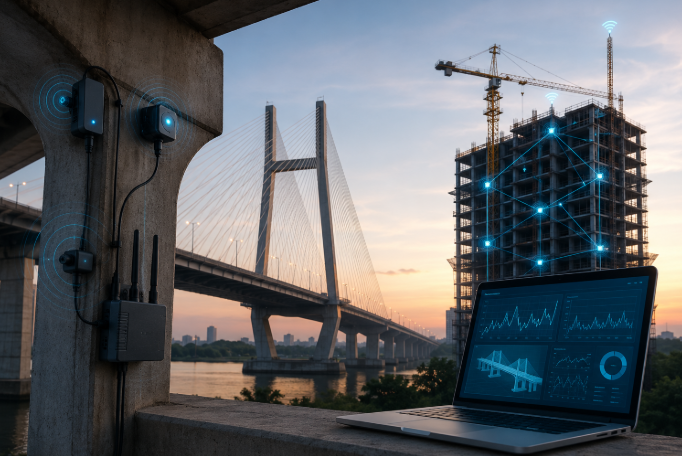
A bridge does not fail on the day of its scheduled inspection. It fails on the days in between, when nobody is watching, when a tilt sensor would have caught a shift that a visual walk-through never could. This is the uncomfortable truth that has quietly reshaped how structural health monitoring companies in India operate over the last few years.
For decades, structural safety in India ran on a calendar. An engineer would visit a bridge, a chimney, or a residential tower once every six or twelve months, run a set of checks, and file a report. Between visits, the structure was essentially on its own. What most people don't realise is that this gap, however small it seems on paper, is exactly where deterioration does its quiet work. Corrosion doesn't wait for your inspection date. Neither does a foundation settle unevenly after monsoon saturation, nor does a bridge deck fatigue under repeated heavy axle loads.
That gap is precisely why real-time IoT sensor networks are becoming the new backbone of structural health monitoring in India, and why forward-looking structural consultants in India are pushing clients toward continuous monitoring instead of periodic snapshots.
Scheduled inspections aren't wrong. They're incomplete.
A traditional structural audit in India typically involves a visual assessment, some non-destructive testing at accessible points, and a report generated from data collected at a single moment in time. It's a photograph, not a video. And a photograph, however carefully composed, cannot show you what happened between one visit and the next.
In our experience working across sectors ranging from pharmaceutical plants to municipal infrastructure, the structures that run into trouble are rarely the ones that were never inspected. They're the ones where something changed quietly between two inspection cycles, a crack that widened after an unusually heavy monsoon. This support shifted after a nearby excavation and a load pattern change caused by a client altering how a warehouse floor was used. None of that shows up until the next scheduled visit, by which point the cost of correction has usually gone up.
Here's where things get interesting. A well-designed IoT sensor network doesn't replace the expertise of a structural engineer. It gives that expertise something it never had before: continuity.
Detectors placed at crucial points on a structure- columns, girders, expansion joints, and foundations continuously capture vibration, tilt, strain, and deflection data. Think of it as the difference between checking someone's pulse once a year versus having a continuous ECG. That comparison isn't a marketing flourish; it's a fairly literal description of what strain gauges and accelerometers do when deployed across a structure. They generate a live signal of structural behaviour, and any deviation from the expected baseline becomes visible almost immediately, not six months later. This matters most in a few specific scenarios:
Many of India's bridges, flyovers, and industrial structures were designed for traffic and load conditions that have since increased severalfold. Real-time monitoring allows engineers to track how a structure is actually behaving under today's loads, not just whether it passed a design check decades ago.
After an earthquake, a flood, or even sustained heavy rainfall, the immediate question is always the same: is the structure still safe to use? With sensor networks already in place, the answer can be generated in hours rather than days because baseline data already exists for comparison.
Dams, high-rises, industrial chimneys, and heritage structures carry a different risk profile from that of a standard commercial building. When the cost of failure is measured in lives rather than repair budgets, continuous monitoring stops being a nice-to-have and becomes a fairly obvious operational decision.
Sensor technology existed a decade ago, too. What's changed is the cost of deployment, the reliability of wireless data transmission, and the sophistication of the analytics layer that turns raw sensor data into something an engineer or a facility manager can actually act on.
There's also a shift in who is asking for this. Insurance providers, regulatory bodies, and institutional asset owners are increasingly expecting documented, continuous evidence of structural performance, not just a certificate issued after a one-time visit. For engineering consultant services in India working with large industrial or infrastructure clients, that expectation alone has been enough to move real-time monitoring from an optional upgrade to a standard recommendation on higher-risk projects.
It's worth being precise about what IoT sensor networks do and don't do. They don't replace a structural audit. A qualified engineer still needs to interpret the data, correlate it with material condition, and make the judgment calls that no algorithm can make on its own. What sensor data does is make that judgment far more informed. Instead of an engineer walking into a structure once a year and reconstructing months of history from visible symptoms, they're working with an actual timeline of the structure's behaviour.
This is really the direction structural health monitoring companies in India are converging toward: audits grounded in continuous data rather than a single visit, and retrofit or repair decisions made with far more confidence because there's a documented pattern behind them, not just a snapshot.
If you own or manage a structure that carries meaningful risk, an ageing bridge, an industrial facility, a high-rise, a dam, or a heritage building- the practical question isn't whether continuous monitoring is worth considering. It's where to start.
A good starting point is usually a structural audit that identifies the specific points on a structure where movement, strain, or deterioration risk is highest, and then layering sensor deployment onto those points rather than instrumenting a structure unthinkingly. This is where working with structural consultants in India who understand both the diagnostic and the monitoring side matters. The two disciplines need to talk to each other, or you end up with a lot of data and very little insight.
At Vijna Consulting Engineers, structural health monitoring has been built around exactly this principle, combining the diagnostic depth of an NABL-accredited testing lab with sensor-based monitoring systems that give asset owners a continuous, evidence-backed view of how their structures are actually performing. If your structure has been running on a once-a-year inspection cycle and you're not entirely sure what's happening in between, that's a conversation worth having sooner rather than later.