


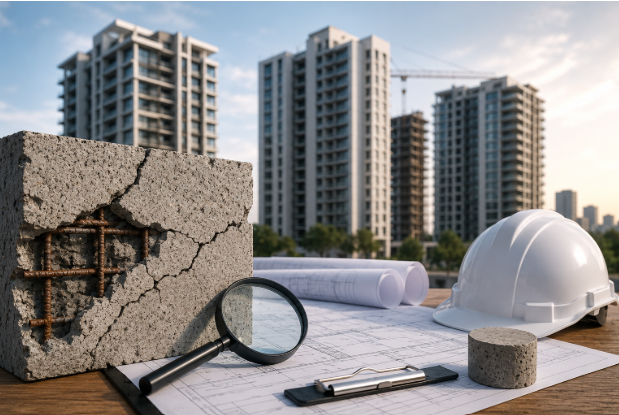
A structural crack that shows up in year four of possession used to be a grey area. Was it the builder's problem or the owner's? Who had documented what the structure looked like at handover? RERA 2.0 has just made that grey area much smaller and much more expensive to ignore.
Launched in March 2026, RERA 2.0 isn't a new law. It's a sharper enforcement layer built on top of the Real Estate (Regulation and Development) Act, 2016. But for anyone involved in a structural audit in India, whether as a consultant, a developer, or a building owner, the practical effect is significant. The reforms tighten escrow monitoring, introduce mandatory third-party audits of project funds, push developers toward digital, publicly trackable dashboards, and standardise accountability norms across states. Underneath all of that sits a provision that predates RERA 2.0 but is now getting far more teeth: the five-year structural defect liability under Section 14(3), which holds a developer responsible for structural defects, artistry issues, and material deficiencies for five years from the date of possession.
Here's where things get interesting for structural audit consultants in India. A law that has existed since 2016 is only useful if it can actually be enforced, and enforcement runs on evidence. RERA 2.0's broader push toward documentation, third-party verification, and transparent, trackable records is exactly the environment where a proper structural audit stops being a discretionary expense and becomes the evidence base that both sides of a real estate transaction now need.
In our experience working on residential, industrial, and institutional projects, developers have traditionally treated structural audits as something to commission only after a problem surfaces, not before. RERA 2.0's tightened accountability framework flips that logic.
If a developer is on the hook for structural defects for five years after handover, the smartest move is to have an independent, dated, and technically rigorous record of the structure's actual condition at the point of possession. Without that baseline, every future dispute becomes a matter of conflicting opinions. With it, a developer has a defensible position: here is what an accredited engineering consultant certified on this date, and here is what has changed since.
This is not a hypothetical. State RERA authorities have already engaged third-party surveyors to evaluate disputed structural claims when developers and buyers disagree. A developer who commissions their own structural audit proactively through qualified structural consultants in India is simply choosing to control the narrative early rather than reacting to it later under regulatory pressure.
What most people don't realise is that the five-year defect liability window is not passive protection. It requires the owner to notice a defect, document it, and report it in writing within the window, ideally with evidence that withstands scrutiny. A verbal complaint about a hairline crack doesn't carry the same weight as a structural audit report that quantifies crack width, correlates it with rebar corrosion risk, and tracks whether it has progressed since a previous inspection.
Owners who wait until a crack becomes visibly alarming are often waiting too long. Deterioration in reinforced concrete, corrosion of embedded steel, and foundation settlement are processes that are frequently underway well before they're visible to an untrained eye. A structural audit conducted early in the possession period and repeated periodically through the defect liability window gives owners exactly what RERA 2.0's evidence-driven framework rewards: a documented, technically credible timeline.
RERA 2.0's emphasis on transparency, standardisation, and third-party verification is part of a broader pattern that engineering consulting services in India have been watching develop for some time. Regulatory bodies, insurers, and institutional stakeholders are converging on the same expectation: don't just tell us the structure is safe, show us the data behind that claim.
This has three practical implications for anyone managing real estate assets in India today.
For developers, a structural audit completed before handover, backed by NABL-accredited testing, is no longer just a compliance formality. It's documentation that protects against inflated or unfounded defect claims later and demonstrates exactly the kind of accountability RERA 2.0 is designed to enforce.
Owners' associations and RWAs would do well to treat the five-year window as an active monitoring period rather than a passive guarantee. A mid-cycle structural audit can catch a developing issue while it's still within the liability period and still the developer's responsibility to fix, rather than discovering it in year six when the clock has run out.
RERA 2.0's push for standardised, digitally accessible records signals where the entire sector is heading. Structural audit reports that are vague, undated, or inconsistent in format will increasingly struggle to hold up in a regulatory environment built around clear, comparable, third-party-verified documentation.
If you're a developer, the message is straightforward: commission a structural audit at handover, keep it on record, and consider periodic monitoring throughout the defect liability period as a form of risk management rather than an added cost.
If you're a building owner, an RWA, or a facility manager, the message is equally direct. Don't wait for a crack to become undeniable before you call in a structural audit consultant. The five-year window under RERA works in your favour, but only if you can produce credible, technical documentation of what changed and when.
At Vijna Consulting Engineers, structural audits are backed by an in-house NABL-accredited testing lab and delivered by licensed structural engineers, producing the independent, defensible documentation that RERA 2.0's tightened framework now expects. Whether you're a developer looking to protect against future disputes or an owner trying to understand what your structure actually looks like beneath the surface, the right time to start that record isn't after something goes wrong. It's now, while the evidence is still easy to establish and the clock on the defect liability period is still running in your favour.