


The slab looks perfectly intact. The paint is fresh. The building passed its last visual inspection without a single flag. And yet, somewhere inside that concrete, behind the cover, along the reinforcing bars, an electrochemical reaction has been quietly dismantling the structure for years.
This is the fundamental problem with reinforcement corrosion: it doesn't announce itself until the damage is already significant. By the time rust stains appear on a beam soffit or chunks of concrete begin to spall off a column, the structural consequence has usually been unfolding for a decade. What you're seeing at that point isn't the beginning of a problem. It's the end stage of one.
This is precisely why corrosion testing, specifically Half-Cell Potential Testing, exists. Not to confirm what's already visible, but to detect what isn't.
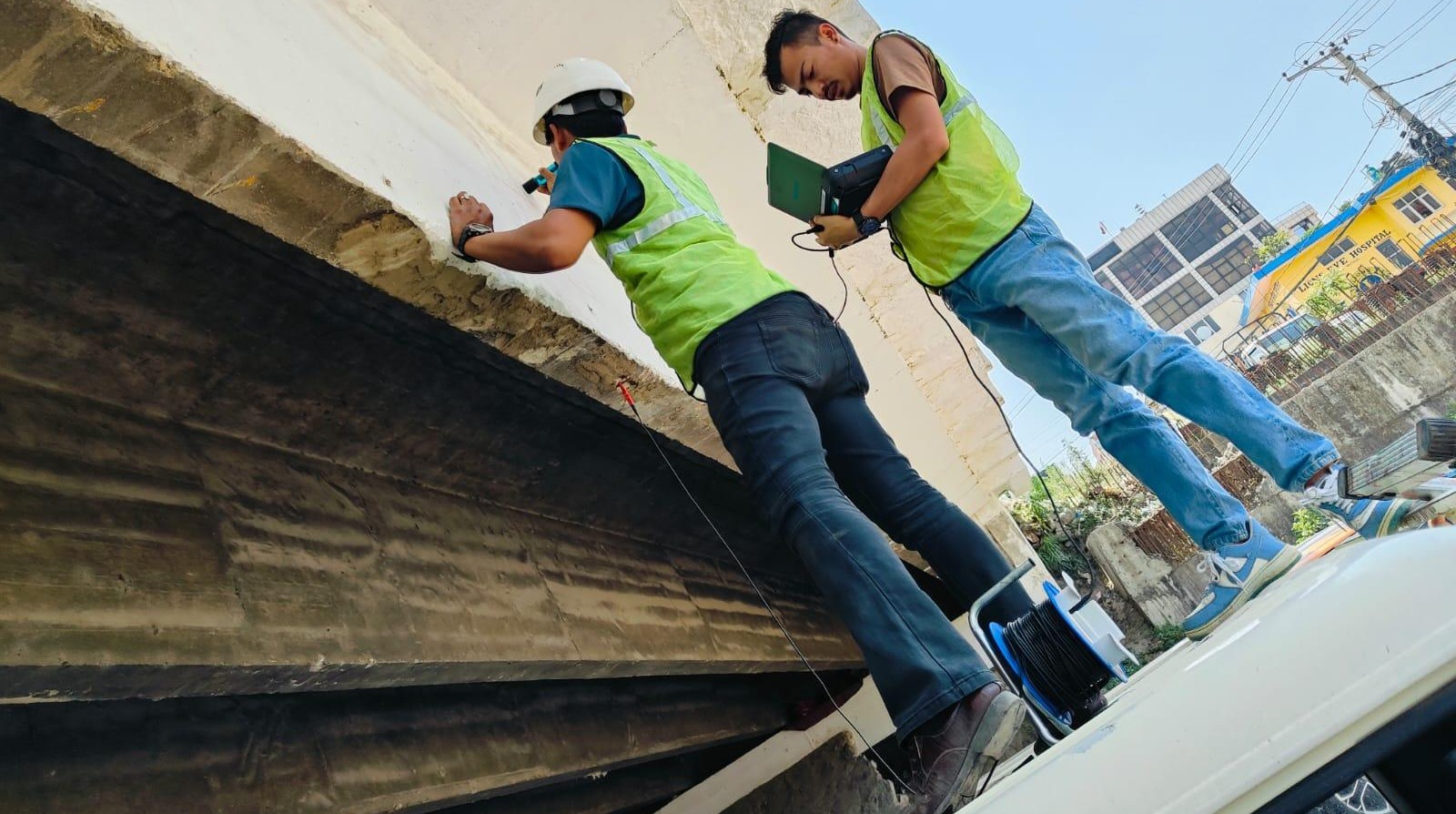
Half-Cell Potential Testing is a non-destructive electrochemical technique used to assess the probability of active reinforcement corrosion within a concrete structure. It works by measuring the electrical potential difference between a reference electrode (the half-cell, typically copper/copper sulphate) placed on the concrete surface, and the embedded reinforcing steel within.
The fundamental principle is straightforward: corroding steel behaves differently from passive, non-corroding steel in terms of electrical potential. When corrosion is active, the steel's electrochemical potential shifts measurably toward the negative. By systematically mapping these voltage readings across a concrete surface, engineers can produce a corrosion probability map, a clear, data-driven picture of where active corrosion is most likely occurring, even when the surface shows nothing unusual at all.
What most people don't realise is that this technique doesn't just tell you whether corrosion might be present. It tells you where and with what level of statistical probability, allowing structural engineers to make targeted, evidence-based decisions about investigation and repair.
This is a point we make often at Vijna Consulting Engineers, and for good reason: visual inspection is a starting point, not a conclusion.
Concrete has a natural alkaline chemistry, a high-pH environment that forms a passive oxide film on reinforcing steel, protecting it from corrosion. The problem is that this protection erodes over time through two primary mechanisms: carbonation (in which atmospheric carbon dioxide reacts with concrete, lowering its pH) and chloride ingress (in which chloride ions from seawater, deicing salts, or marine environments penetrate the cover and directly disrupt the passive film).
Both processes operate well below the surface, invisibly, for years before any outward sign appears. By the time visible cracking, rust staining, or delamination occurs, the steel section may have already lost significant cross-sectional area, reducing its load-carrying capacity in ways that don't appear on any visual inspection checklist.
Corrosion testing through Half-Cell Potential Mapping captures this process during its active, pre-damage phase, when intervention is still straightforward and cost-effective.
Understanding the process demystifies it, and helps building owners and facility managers appreciate what they're commissioning.
The test begins by establishing electrical continuity between the measurement instrument and the reinforcing steel, typically via a small drilled access point or an existing exposed bar. The concrete surface is then pre-wetted to ensure consistent electrical contact, and the half-cell electrode is moved systematically across the surface in a defined grid pattern.
At each grid point, the voltage reading is recorded. These readings, expressed in millivolts (mV), are then plotted to create an equipotential contour map of the entire surveyed area, similar in concept to a topographic map. Areas of strongly negative potential are flagged as zones of high corrosion probability.
The interpretation follows the criteria established by ASTM C876, the standard governing this test method:
Here's where things get interesting: the test results are most powerful when interpreted alongside other corrosion-testing data, carbonation depth measurements, chloride content analyses, and cover depth readings from reinforcement mapping. In isolation, a potential reading tells you about corrosion probability. In context, it tells you about corrosion risk, a far more useful engineering judgment.
Not every structure presents the same corrosion risk profile, and corrosion testing should be allocated strategically. In our experience, the following situations consistently benefit most from Half-Cell Potential surveys:
Coastal and Marine Structures: Chloride-laden environments, Mumbai, Chennai, Kochi, Vizag and their surrounding regions, accelerate reinforcement corrosion dramatically. Bridges, jetties, waterfront buildings, and port infrastructure in these areas are prime candidates for regular Half-Cell Potential surveys as part of a durability monitoring programme.
Buildings Beyond 20 Years in High-Humidity Zones: Once concrete cover reaches significant carbonation depth, the passive protection on reinforcing steel begins to fail. Corrosion testing at this stage establishes a clear baseline and informs retrofit planning before structural capacity is meaningfully compromised.
Post-Repair Assessment: After a corrosion repair programme, whether localised patch repair or cathodic protection, Half-Cell Potential Testing is the most reliable method to verify that active corrosion has been arrested and that the intervention was effective.
Industrial and Pharmaceutical Facilities: Environments with chemical exposure, high humidity, or process-related moisture are structurally aggressive. Periodic corrosion testing in these settings is as much a production continuity decision as a safety one; a structural failure in an active manufacturing environment has consequences that extend well beyond the building itself.
Bridges and Elevated Structures: The combination of dynamic loading, environmental exposure, and limited visual access makes regular corrosion testing particularly valuable for bridge decks, piers, and elevated road structures, where early detection can delay or avoid expensive rehabilitation programmes.
It's worth being clear about the limits of the technique, because responsible corrosion testing always involves knowing what a method can and cannot tell you.
Half-Cell Potential Testing measures the probability of corrosion, not the extent of corrosion. It indicates where the electrochemical conditions for active corrosion are present, but it does not directly quantify how much steel has been lost or the remaining structural capacity.
That determination requires correlation with complementary data: cover depth measurements, core samples for chloride profile and compressive strength where warranted, and ultimately, structural analysis of the affected members. Half-Cell Potential Testing is therefore most accurately described as a diagnostic triage tool; it identifies where to look, so that the subsequent investigation is targeted, efficient, and technically defensible.
This is how we approach corrosion testing at Vijna Consulting Engineers. The Half-Cell Potential survey is the opening instrument in an orchestra of NDT methods, each adding a layer of evidence until the structural picture is complete.
There is a direct and quantifiable relationship between the stage at which corrosion is detected and the cost of addressing it.
Corrosion identified during the electrochemical initiation phase, detectable through Half-Cell Potential Testing before any physical damage is visible, can often be managed through protective coatings, waterproofing interventions, or monitoring programmes. The cost is measured in thousands of rupees per intervention zone.
Corrosion identified at the cracking and spalling stage requires concrete removal, reinforcement treatment or replacement, and patch repair with compatible materials. Costs are typically ten to twenty times higher per square metre than those of early-stage interventions.
Corrosion identified only after structural capacity has been significantly reduced may require full member replacement, temporary shoring, or, in extreme cases, building demolition. The financial multiplier at this stage is no longer calculable in terms of repair; it becomes a question of total asset value.
Regular corrosion testing is not an expense. It is the mechanism by which expensive problems are converted into manageable ones.
There is an important distinction between corrosion testing that generates a report and corrosion testing that generates an engineering decision.
At Vijna Consulting Engineers, Half-Cell Potential surveys are conducted by engineers who understand what the numbers mean in the context of structural behaviour, not simply in relation to an ASTM table. The equipotential maps we produce are accompanied by interpretation, risk grading, and clear recommendations that an owner, facility manager, or structural engineer can act on.
Our in-house NABL-accredited laboratory supports the corrosion testing process with complementary analyses, chloride content testing, carbonation depth measurement, and concrete core compression testing, ensuring that the full picture of structural durability is understood, not just one data point within it.
Reinforcement corrosion is not a problem that stabilises on its own. Once initiated, the process accelerates: the expanding rust products create tensile stress in the surrounding concrete, which cracks, admitting more moisture and chloride, which further accelerates corrosion. It is a self-reinforcing cycle that only moves in one direction without intervention.
The buildings and infrastructure we depend on deserve more than a visual inspection and a hope that the surface tells the full story. They deserve the kind of corrosion testing that looks past the surface, that finds the problem where it actually lives, before it decides to announce itself in the worst possible way.
If your structure is in a high-exposure environment, beyond 15 years of age, or hasn't had a Half-Cell Potential survey as part of its last structural assessment, that conversation is worth having sooner rather than later.