


A structural audit report lands on a facility manager's desk. Half-cell potential mapping shows "high probability of corrosion" across a chunk of the slab. The facility manager reads it twice, then asks the one question the report doesn't answer: how fast is this actually happening? Is this a five-year problem or a twenty-year one? Half-cell data tells you corrosion is probably active. It says nothing about the rate. And rate is exactly what determines whether you're planning a retrofit this quarter or simply keeping an eye on things for the next few years.
This is the gap the Galva Pulse Test was built to close.
Half-cell potential testing has been the default first step in reinforcement corrosion assessment for decades, and for good reason: it's fast, non-destructive, and effective at flagging where corrosion activity is likely. But what most people don't realise is that potential mapping is a probability indicator, not a measurement. It tells you where steel is electrochemically unhappy. It doesn't tell you how much section loss is occurring per year, or whether the corrosion has stalled, accelerated, or gone quiet under a patch repair that looked fine on the surface.
For anyone making a real decision- repair now, repair later, or monitor- that missing piece matters. This is where a quantitative corrosion rate technique earns its place in the assessment.
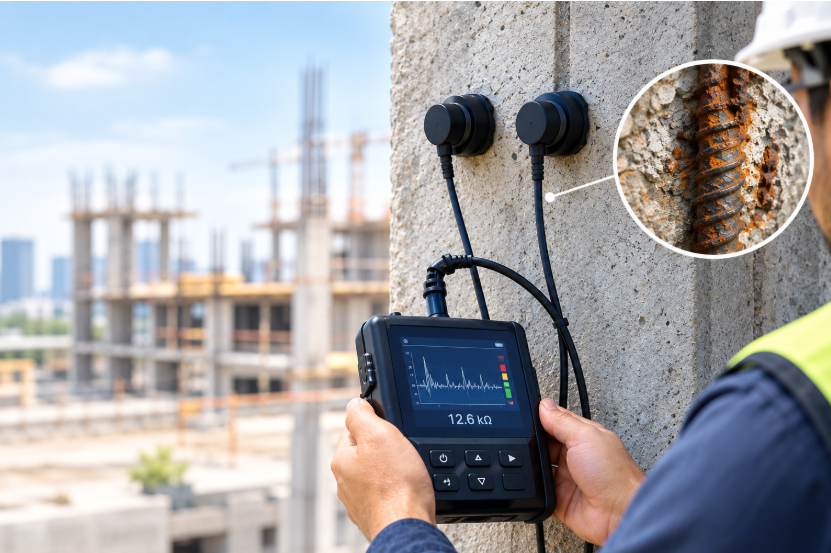
The Galva Pulse Test is a non-destructive electrochemical method that measures the instantaneous corrosion rate of reinforcement steel embedded in concrete, rather than simply flagging corrosion risk. In our experience, it turns a qualitative red flag into a number a structural engineer can design around.
The underlying principle is polarisation resistance. A small, controlled galvanic pulse is applied to the rebar through a sensor placed on the concrete surface, and the instrument measures the resulting shift in electrochemical potential over a short duration. That shift is used to calculate the steel's polarisation resistance, a value inversely proportional to how actively the rebar is corroding. Run that resistance value through the Stern-Geary relationship, and you get corrosion current density, expressed in microamps per square centimetre. That figure translates into a practical classification: passive, low, moderate, or high corrosion activity.
None of this requires breaking into the concrete. That's the appeal of the galvanostatic pulse method over destructive alternatives: you get quantitative, lab-grade electrochemical data from a structure that stays fully in service throughout testing.
The process itself is straightforward once you've done it a few hundred times, though the sequencing matters for accuracy. The concrete surface over the rebar is lightly prepared and, where needed, wetted to ensure consistent electrical contact. A connection is made to the reinforcement itself, usually through a small exposed point. The sensor's guard ring is then placed directly over the bar, the pulse is applied, and the instrument logs the potential response in real time.
Here's where things get interesting: the guard ring isn't decorative. It confines the current to the area directly beneath the sensor, keeping the reading specific to that section of rebar rather than picking up interference from adjacent reinforcement. Skip that step, or use uncalibrated equipment, and the corrosion rate reading can drift meaningfully from what's actually happening in the steel.
A Galva Pulse Test reading isn't useful in isolation; it's useful because it slots into a recognised classification scale. Corrosion current density readings are generally grouped into passive, low, moderate, and high corrosion-rate bands. A passive reading means the steel's protective oxide layer is intact and corrosion, if any, is negligible. A high reading means active, ongoing metal loss, the kind that, left alone, shows up later as cracking, spalling, and reduced load capacity.
What makes this genuinely useful for planning is that you can repeat the test at the same points over time. Run it once, and you know where you stand today. Run it again after a repair, or a year later on an untouched structure, and you know whether the corrosion is accelerating, stable, or arrested. That's a very different conversation with a client than a one-time risk flag.
Not every structure needs this level of testing, and that's worth saying plainly rather than pushing it as a default. It earns its place in specific situations:
It's worth being clear that the Galva Pulse Test isn't a replacement for half-cell potential mapping, carbonation depth testing, or chloride content analysis; it complements them. Half-cell tells you where to look. Carbonation depth and chloride profiling tell you why corrosion is likely to be occurring. The Galva Pulse Test tells you how fast it's actually happening right now. Together, these four form a genuinely complete corrosion diagnosis rather than a partial one, which is why they're rarely used in isolation on any structure where the findings will inform a repair budget.
At VCEPL, Galva Pulse testing sits within a broader durability and corrosion testing programme, with half-cell potential, carbonation depth, chloride and sulphate analysis, and reinforcement mapping running alongside it, and results consolidated into a single technical report rather than handed over as disconnected data points. For clients running durability and corrosion testing in Thane and across our pan-India project base, that combination turns a diagnostic report into a decision tool: which sections need immediate intervention, which can be monitored, and what a retrofit scheme should realistically target.
If a structure on your books has an ambiguous half-cell reading, or you're heading into a retrofit design without a clear sense of active corrosion rate, that's precisely the gap a Galva Pulse Test is meant to close. Reach out to our team, and we'll walk you through what a proper durability assessment looks like for your structure.
