


An old masonry building is up for a change of use, heavier floor loading, an extra storey, maybe a seismic retrofit mandated by a municipal notice. Someone pulls up the original drawings, if they still exist, and finds a one-line spec: "brick masonry in lime mortar." That's it. No compressive strength value, no modulus of elasticity, nothing a structural engineer can actually design against. And you can't exactly core out a chunk of a century-old load-bearing wall to send to a lab without weakening the very structure you're trying to assess.
This is the exact problem the double flat jack test was developed to solve.
Concrete has it relatively easy; cores can be extracted, cubes can be cast, and destructive testing rarely threatens the integrity of the structure being assessed. Masonry doesn't offer that luxury. Removing a representative sample from a load-bearing wall changes the stress path around it, and for heritage or historically sensitive structures, it's often simply not permitted. What most people don't realise is that this isn't a minor inconvenience; it's the reason masonry strength assessment lagged behind concrete assessment for decades, with engineers falling back on generic code-based strength tables that may bear little resemblance to what's actually holding a particular building up.
The double flat jack test exists to close that gap: it pulls real, wall-specific mechanical data from masonry without meaningfully damaging it.
Where a single flat jack test estimates the existing compressive stress already present in a wall, the double flat jack test goes a step further and determines the masonry's deformability, its modulus of elasticity, along with a reasonable estimate of its compressive strength. In our experience, this distinction matters most to clients: a single flat jack tells you what stress the wall is already carrying, while the double flat jack test tells you how much more it can take.
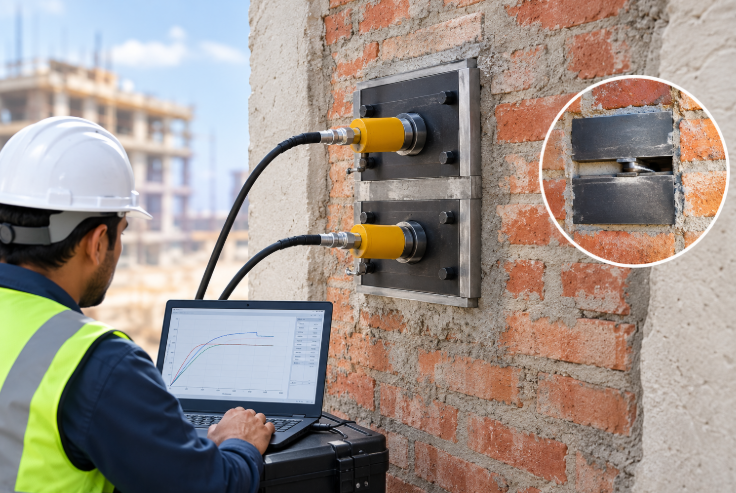
Two horizontal slots are cut into the mortar joints of the wall, parallel to each other and typically one to four courses apart. A thin, flat hydraulic jack is inserted into each slot. Once both jacks are in place, they're pressurised simultaneously and gradually, applying a controlled compressive load to the masonry sandwiched between them.
Here's where things get interesting: as pressure increases, displacement gauges fixed to the wall surface track the deformation of the masonry between the two jacks. Plotting stress against strain as the load ramps up gives a genuine stress-strain curve for that specific section of wall, from which the modulus of elasticity is derived directly. Compressive strength is then estimated from that same data set, calibrated against known relationships for the masonry type involved.
The wall stays standing throughout. Once testing is complete, the slots are grouted and repointed, and the structure is effectively as it was; this is why the double flat jack test is generally classified as minor-destructive rather than destructive.
Generic masonry strength values in design codes are built for typical, well-understood construction, uniform brick, consistent mortar, predictable coursing. Real buildings, especially older ones, rarely match that description cleanly. Mortar composition drifts across renovation phases, brick quality varies by source and era, and decades of moisture ingress or prior repair work change the picture further. A double flat jack test gives you the actual modulus of elasticity and strength of the wall in front of you, not an assumption borrowed from a table built for a different building entirely.
That distinction becomes critical the moment the assessment feeds into something consequential: a change-of-use load calculation, a seismic retrofit scheme, or a heritage conservation plan where every intervention must be justified against real structural capacity rather than a conservative guess.
Not every masonry structure needs this level of testing, but it earns its place in a few recurring scenarios:
In each of these, a double flat jack test replaces an assumption with a measurement, and that shift changes what an engineer is willing to sign off on.
Masonry testing rarely stands alone in a good structural audit in India, particularly for buildings that predate modern RCC construction or combine masonry with later concrete interventions. At VCEPL, double flat jack testing typically runs alongside broader structural audit protocols, visual condition assessment, non-destructive testing, and, where reinforcement is present, corrosion diagnostics, so that the final report reflects the structure's actual load-carrying capacity rather than a set of disconnected observations. For clients managing legacy structures, heritage buildings, or masonry-RCC hybrid construction anywhere across our pan-India project base, this is the difference between a report that states a risk and one that gives you a number to design against.
If a structure in your portfolio needs its actual masonry strength verified, not assumed, that's exactly the conversation to have with our structural audit team before finalising any retrofit or change-of-use plan.
