


An 80-page structural audit lands on a facility manager's desk in March. It has rebound hammer readings, crack maps, half-cell potential values and a clear list of recommendations. It is a good report. By October, a heavier machine has been installed on the second floor, the monsoon has pushed moisture deeper into the slab edges, and a corner of the building has started to vibrate in a way nobody had noticed before. The report is still accurate, but it now describes a building that no longer exists exactly as written.
That gap between the day of inspection and the day of decision is the reason a digital twin for buildings is moving out of conference slides and into real site discussions in India. Not as a buzzword, but as a practical answer to a simple question: what is my structure doing right now, and what will it do next?
A structural audit is a snapshot. A well-done one is invaluable because it tells you the condition of the concrete, the position and state of the reinforcement, the depth of carbonation, and the likely causes of distress. We rely on it every day, and nothing replaces it as a starting point.
But a snapshot has a shelf life. Structures change with loading, temperature, moisture, corrosion and time. Most people don't realise the most dangerous changes are rarely dramatic. A deflection that grows a fraction of a millimetre over a season. A tilt that creeps in one direction. A vibration frequency that shifts slightly because stiffness has dropped somewhere. None of these shows up in a report written months earlier, and none are visible to a walkthrough.
This is where continuous monitoring and digital modelling come in.
Let's clear up a common confusion. A digital twin for buildings isn't a pretty 3D render, and it isn't a dashboard with coloured gauges. It is a living digital model of a real structure, kept in sync with that structure through measured data.
Think of it as three layers stacked on top of each other. If any layer is weak, the twin is just decoration.
You cannot model what you have not measured. For older buildings in particular, original drawings are often missing, outdated, or simply wrong because of decades of modifications. As-built 3D modelling through LiDAR scanning solves this by capturing the structure's real geometry with high accuracy. The same approach has been used on heritage buildings as significant as Rashtrapati Bhavan, where precise as-built information was the foundation for everything that followed.
Reinforcement mapping adds the next detail: where the bars actually are, their diameter, and how the structure was built, not how it was meant to be built.
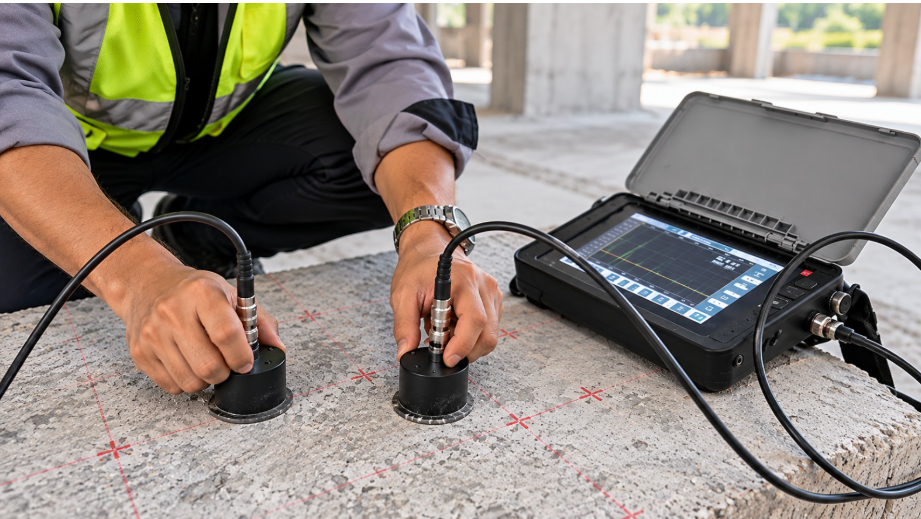
Geometry tells you the shape. It says nothing about the health of the material inside. This is where the traditional toolkit earns its place: ultrasonic pulse velocity to check concrete homogeneity and voids, rebound hammer for uniformity, core testing for in-situ strength, carbonation depth and half-cell potential to understand corrosion risk.
In our experience, this layer is where many conversations about a digital twin for buildings quietly fall apart. A model fed with assumed material properties will give assumed answers. Test data from a calibrated, accredited lab is what turns a model into something you can trust.
This is the layer that makes the twin "real-time." Sensors installed on the structure capture how it responds to actual loads and conditions: strain gauges on concrete and steel, vibrating wire gauges for long-term strain, LVDTs for displacement, accelerometers for dynamic response, tiltmeters for rotation and bearing sensors on bridges.
We often describe a structural health monitoring system as a structure's ECG. It records the pulse: vibrations, tilt, strain and deflection. When you feed that pulse into a model calibrated against real test data, it stops being a prediction and starts being a reflection.
Indian infrastructure runs under demanding conditions. Coastal cities deal with chloride-laden air that quietly attacks reinforcement. The monsoon brings wetting-and-drying cycles that open cracks and accelerate corrosion. Many commercial and industrial buildings change use over time, so a floor designed for offices ends up carrying equipment, storage or machinery it was never meant for. Railway bridges and road overbridges take heavy, repeated dynamic loads every single day.
Add to this the number of ageing structures with thin documentation, and the argument becomes clear. Periodic inspection alone is a thin safety net when the loading and the environment keep changing between visits.
Not every structure needs a digital twin for buildings on day one. Here's where we see the strongest case:
Building the model before asking the question. A twin should answer something specific: is this slab safe for the new equipment, is this bridge bearing behaving normally, is this crack still moving? Without a question, you collect data nobody uses.
Installing sensors without a baseline. Readings only mean something when compared against a known starting condition. A proper audit and testing phase comes first.
Ignoring calibration and sensor quality. Cheap or poorly installed sensors produce noise, and noise creates false alarms or, worse, false comfort. Instrument quality and correct installation matter as much as the software.
Treating it as a one-time project. A twin only stays a twin if the data keeps flowing and the model keeps being checked against reality.
You do not need to jump straight to a fully automated model. A sensible path looks like this:
Notice that the model comes late in this list. The structural engineering comes first, and that is deliberate.
The move from inspection reports to digital twins is not about replacing engineers with software. It gives engineers and building owners a continuous view instead of an annual one. Inspection tells you what condition a structure was in. A digital twin for buildings, built on sound testing and reliable monitoring, shows how that condition is evolving, letting you act before a small problem becomes expensive or unsafe.
If you own or manage a structure where the report on your desk feels older than the building's current behaviour, it may be worth a conversation about what a structural audit combined with long-term monitoring could look like for your building. Our team at Vijna Consulting Engineers is happy to talk it through.
